
Aesthetic Ecology
We’ve seen the photos of lots reclaimed by nature, with shrubs and grasses so tall that you can’t even see the house. I grew up down the street from a home like this. The only visible item amongst all the foliage was a Certified Wildlife Habitat sign!
For some people and some locations, this style works and makes them and the creatures around them happy. For the majority of people, especially those in suburban or urban settings or those with a HOA, this is neither desirable nor feasible. Unfortunately, this unmaintained style has somehow become synonymous with ecological landscaping. I’m here to tell you that it is possible to have manicured landscaping that is attractive to your, your neighbors, and wildlife.
Best-selling author and ecologist Douglas Tallamy summarizes this best in his book “Nature’s Best Hope”:
Many people equate native landscaping with a total lack of planning, where the property is just left to go wild. We can combat this misconception by designing artful landscapes that will differ from traditional landscape designs in only three ways: they will have less lawn, with more plants in total, and more of those plants will be the powerhouse species that drive food webs and support pollinators. The single required feature of an HOA-approved landscape is that it be cared for. It’s easy to put cues for care front and center in our yard for all to see.
There are times when the news can become overwhelming and demoralizing. A 45% decline in insect populations globally seems like more than one person can fix. But as Tallamy shares, homeowners control a substantial portion of land and we are currently nature’s best hope for addressing these issues. We can make a tangible difference in the world around us with Tallamy’s 3 steps!
MANAGE LAWN SIZE
First, ask yourself an important question - “how do I want to use my lawn?” Do you have children and you want a safe space for them to play? Do you need a dog potty area that’s easy to clean up? Do you want a place to gather with loved ones for celebrations?
Now, figure out if a lawn is the best option for this. Is your kid more likely to be playing sports at a school field or public park basketball court with their friends than in your yard? Would they enjoy having a garden to explore and play in or do they have an activity they love that would be improved by having a lawn at home? Would your dog be happier patrolling the perimeter of your property on a path made specially for them, playing with other dogs at a dog park, or getting zoomies through the grass at home? Do you want to stand in the grass at parties or would a water-permeable patio be more conducive for festivities?
By working your way through these questions, you start to have a better idea of your needs and potential lawn size for the space. Authors Thomas Rainer and Claudia West advise in their book “Planting in a Post-Wild World” to think of the lawn as an area rug, not a full-room carpet. If the only time you interact with your lawn is when you cut it, you should consider doing something more productive with that space. Your wallet and the wildlife will thank you!
MAXIMIZE PLANT SPECIES
In most yards, we just see two extremes: an expanse of low grass and occasional tall trees. We are missing a large - and visually interesting - swath of plants by excluding ground covers, annuals, perennials, shrubs, climbers, and small trees. Not only are they beautiful, but they also fill an important ecological niche! For instance, over 90% of pupating caterpillars drop from their host plants to the ground. By adding understory plantings, we give these caterpillars a place to hide and grow, safe from lawnmower blades and hungry predators.
A common concern I hear is about visual overwhelm. Some people think the only way to have a refined garden is through a minimal collection of plants. While planting multiples of the same species in an area can be impactful, it isn’t the only way to garden. In fact, it can become monotonous and boring without contrast and diversity throughout the seasons. Through intentional design and planning, it is very possible to increase the number of species without the result seeming chaotic.
Remember that your garden probably has multiple microclimates throughout the property. A microclimate is a small area that has a different climate from the surrounding area. Perhaps there’s a shady side path, a hot sunny wall, or a cool moist area under the tree canopy.
There’s a vast array of native plants throughout the world and they don’t all have the same needs. Some need full sun, others need full shade. Some require heat to grow, others seem to melt in the sun. Some will die with summer watering, others have to live near constant moisture. By recognizing the microclimates in your yard and planting based on species that thrive in those specific conditions, you will automatically incorporate a wider selection of plants.
The next time you’re near a natural area, pay attention to the ways the native plants interact in different habitats. Do you notice any patterns or relationships? Try to mirror those in your own garden. There’s something inherently settling about a garden that feels grounded in place, like it belongs in the context of the region.
Another way to maximize plant species is through color palettes. Color theory is your friend here! Tying in plant species with similar tones creates a cohesive look. I personally love a garden palette of pinks, purples, and blues. Another option to keep the design visually calm would be a mix of green and white, colors that are traditionally considered soothing. Contrasting leaf textures keep this design option interesting but subdued.
Consider as well the bloom cycles for the plants you’ve chosen. Do the flowering windows overlap? Or do you have the ability to shift the palette in the garden throughout the year for seasonal interest?
Varying the heights of the planting beds is another way to increase plant species without it seeming chaotic. Incorporating a mix of shrubs, herbaceous perennials, and groundcover creates defined layers that break up the design and prevent your yard from turning into a wall of green.
Continuing the idea of honoring place, consider the type of habitat that you are trying to mirror and use that as a guide. For example, you could be inspired by a forest area that transitions to a woodland edge and then to a meadow. There’s a flow of species and heights that brings balance and can be scaled to the residential setting.
Analyzing microclimates, incorporating intentional color palettes, and mimicking nature are great ways to increase plant biodiversity while still designing an intentional, manicured, and beautiful space. We don’t have to compromise aesthetics to achieve an environmentally impactful garden.
FEATURE POWERHOUSE SPECIES
When we’re looking at the biodiversity in our planting plan, it’s important to prioritize the plants that create the largest ecological impact. Luckily, there are several great resources to help gardeners figure out what these species are.
Tallamy created an organization called Homegrown National Park. On that website, there’s a section under the Plant Native heading called “Find Keystone Plants.” Keystone species are those that do the heavy lifting to support the ecosystem around them. You can search based on your eco-region to see the keystone native plants where you live. There’s a variety of sorting tools, including the ability to select for container friendly plants. Our patios and terraces can help the earth too!
The National Wildlife Federation lets you search Keystone Native Plant Lists by ecoregion and Native Plants by zip code. They include a ranking for each plant showing the number of butterflies and moths that use it as a host plant, helping you source the most impactful options.
The NWF also have an application to certify your garden as a Certified Wildlife Habitat. It’s incredibly helpful for people feeling overwhelmed by the garden design process because it includes a checklist of categories. This checklist includes native plants, food, water, cover, places to raise young, and sustainable practices. These guidelines also have examples of ways to fulfill the category requirements, potentially inspiring new design ideas.
Great Plant Picks is a helpful resource for gardeners in the Pacific Northwest. This organization has compiled a list of exceptional plants that thrive in the region. While they include non-natives, they do have a native section in their Plant Lists tab. Their resources include a huge list of nurseries that carry their recommended plants, a glossary of common plant terms to help new gardeners, and helpful links to plant resources in the region.
For my friends in California, I am obsessed with Calscape. I wish each state could have a website like this. In large states with very differing biomes, saying a plant is native to the state doesn’t mean much. You need to plant based on the eco-region of your garden.
Started by the California Native Plant Society, the Calscape search engine filters native plants based on your address. This approach guarantees that the plants on your list are native to your specific area. It also tells you how many butterflies and moths are supported by each species, helping you find more of those keystone species.
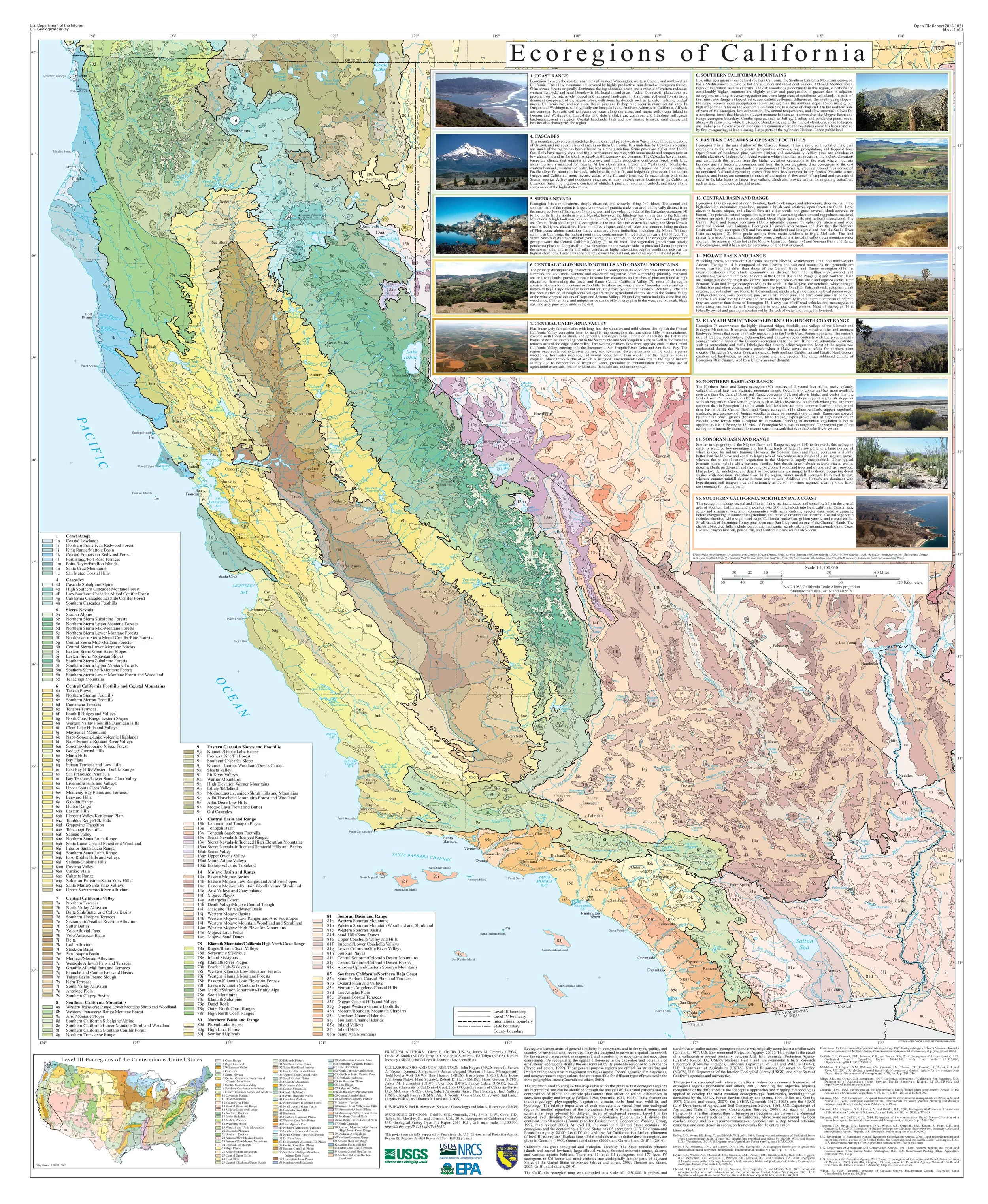
This Ecoregions of California Map highlights the very different environments throughout the state. There are 13 ecoregions, ranging from Coast to Cascades. You can see how a plant that’s “native to California” might not necessarily thrive throughout all of California.
These resources are a great start to supporting a biologically dense ecosystem, even in a small garden. When a single native plant has the potential to support hundreds of different species, your contribution does make a difference in your ecosystem.
FINAL THOUGHTS
The state of the world can be daunting and overwhelming. Statistics can be scary. Conservation and ecological regulations require cooperation on a governmental scale beyond our immediate control. However, fatalism won’t save our pollinators and everything in the food web that relies on them (us included)!
We may not be able to save the entire world right away, but we can start planting the seeds for a better future in our own communities. The native plants in your garden matter. Happy gardening!
REFERENCES
Tallamy, Douglas W.. Nature's Best Hope: A New Approach to Conservation That Starts in Your Yard. Timber Press, 2019. Page 200.
D.L. Wagner, E.M. Grames, M.L. Forister, M.R. Berenbaum, & D. Stopak, Insect decline in the Anthropocene: Death by a thousand cuts, Proc. Natl. Acad. Sci. U.S.A. 118 (2) e2023989118, https://doi.org/10.1073/pnas.2023989118 (2021).Insect decline in the Anthropocene: Death by a thousand cuts | PNAS
Rainer, Thomas and Claudia West. Planting in a Post-wild World: Designing Plant Communities for Resilient Landscapes. 2016.
Tallamy, Douglas W.. Nature's Best Hope: A New Approach to Conservation That Starts in Your Yard. Timber Press, 2019. Page 209.
Kemppinen, J., Lembrechts, J. J., Van Meerbeek, K., Carnicer, J., Chardon, N. I., Kardol, P., Lenoir, J., Liu, D., Maclean, I., Pergl, J., Saccone, P., Senior, R. A., Shen, T., Słowińska, S., Vandvik, V., von Oppen, J., Aalto, J., Ayalew, B., Bates, O., … De Frenne, P. (2024). Microclimate, an important part of ecology and biogeography. Global Ecology and Biogeography, 33, e13834. https://doi.org/10.1111/geb.13834
Griffith, G.E., Omernik, J.M., Smith, D.W., Cook, T.D., Tallyn, E., Moseley, K., and Johnson, C.B., 2016, Ecoregions of California (poster): U.S. Geological Survey Open-File Report 2016–1021, with map, scale 1:1,100,000, https://dx.doi.org/10.3133/ofr20161021.
Great Plant Picks: Unbeatable Plants for the Maritime Northwest Garden